
What Qi Gong has taught me and why I did not go “all the way” in my one-year shaolin online course (led by the teachers of the Shaolin Temple Europe)
I greet you, my inquisitive fellow students of human growth,
I hope the following lines do not take away approximately 10 minutes of your precious lifetime here on earth without adding value to every single second of it.
The teacher
Shifu Shi Heng Yi (35th generation shaolin master) is half Vietnamese, half German and founder of the Shaolin Temple Europe in Otterberg, Germany. If one digs a bit deeper, it seems to be the case that he is also a very kind, hardworking individual who enjoys the occasional oolong tea ceremony, likes to share his perspective (a lot of podcasts and interviews have been conducted lately) and who practices an awful lot of self-controlling/letting-go-of-self tasks (e.g. Qi Gong, Shaolin forms, barehanded stone-crushing).
Qi Gong Form “Ba Duan Jin”
The first time I saw Shifu perform the Qi Gong form Ba Duan Jin (you can find it on YouTube), I was mesmerised, and I could not look away. The slow movements, the focused eyes, the grace and calmness of the whole performance completely stunned me. I saw something in him that I knew I wanted to develop within myself as well. So, I have started practicing the form on a regular basis (and still do). Additionally, I started a training group in school and for the last two years a few teachers and the occasional student have practiced the form with me before official school hours start.
One of my numerous Achilles tendons is sticking to a workout routine for a longer period. You might be able to relate to this. Shifu’s accompanying tips and perspectives helped me to stay consistent. The most resonating one for me was (wording might deviate from the original source): “Freedom is not about doing what you want. It is about freeing yourself from all the wishes you think you want and do something meaningful for yourself and others instead.” Apart from the one-year shaolin online course, I simultaneously attended nearby Qi Gong (turns out this is merely an umbrella term for various methods practiced in China) seminars as well.
What impresses me most is the timelessness of Qi Gong. It has been here for a couple of thousand years. There is no brand, person, or franchise behind the movements. It has been created by and for the people and you can feel the difference, especially in an era of highly efficient and ever-present (social media) marketing. The Lindy effect states that the longer something exists, the higher the chances that it will continue to exist in the future. After practicing the Ba Duan Jin for almost three years now, I feel that the form is here to stay.
Why?
First, all positions are done standing. This is a huge advantage compared to some other (originally) far-eastern movement cultures such as yoga, where you rely on a mat – at least if you want to get in a dedicated practice session. Since I am an outdoor enthusiast, I love to be able to move spontaneously wherever I am. Qi Gong allows me to not only do just that, but I can move and feel my body without having to think about it anymore. Unfortunately, I had to do hundreds if not thousands of repetitions to arrive at that place and for the practice to become something of pure enjoyment you first need to overcome a few obstacles (at least in my case).
The Ba Duan Jin form itself is also called the Eight Brocade Exercise and it stands on three pillars: body, mind-intent and breath. Each position is preceded by one full breathing cycle while your arms move up and down. What I noticed over time is that the posterior pelvic tilt, the bent knees (like a demi plie) and the centre of mass on the heels had a lasting positive impact on my proprioception. This manifests itself in every move I perform throughout the day.
Another great advantage of the practice is that each exercise has so many different benefits that are not necessarily connected to the body but have a deeper impact. The Mabu stance, for instance, is practiced in a variety of movement cultures (e.g. karate). However, doing the wide horse stance in the context of Qi Gong, at least for me, entails additional value and the more I have practiced it, the more insight I have gained. Soft tissue is trained (e.g. leg endurance, flexibility for middle splits) but so is the way in which you experience and deal with yourself as well as your surroundings. As a beginner, your mind will start to resist the isometric hold within the first minute. But once you can push through, you set yourself a new personal limit on mental toughness. Another benefit: The position forces you to take up space in this world. Of course, everyone might get something else out of the Mabu practice but for me (as of right now) notions of grounding, setting new limits and taking up space are the benefits I feel while holding the position.
The One-year Shaolin Online Course
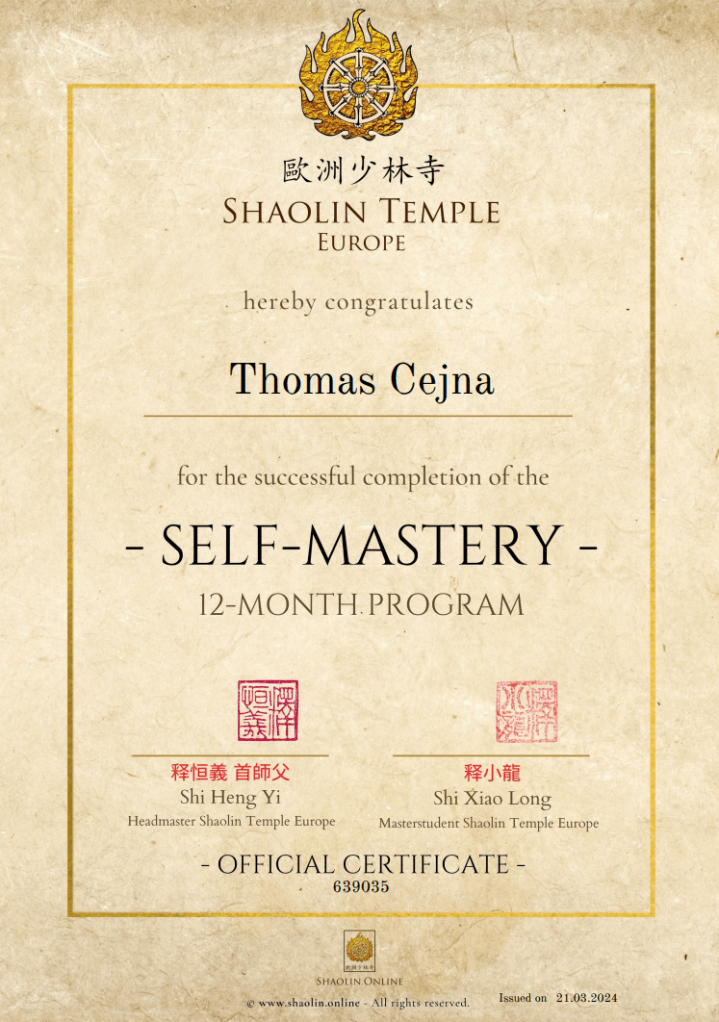
Another often cited Shi Heng Yi statement is: “There are only two mistakes along the way; not starting and not going all the way.” I must admit that I did not go “all the way” because of a couple of reasons (e.g. seven months into the course I became a father) and I do not think continuously redirecting and recreating your own way is necessarily a bad thing.
The course included live sessions, theory lessons and many follow along videos. A lot of practices had to be added to the “Lifelong Rituals” list, meaning you were supposed to keep practicing them throughout your life. After each lesson there was the possibility to write down notes. In the live sessions, students were encouraged to ask questions. The further the course progressed, the longer it would have taken up to complete the plethora of tasks assigned by the teachers (at least 2 hours daily). I really liked most of teachings and practices, but I have no intention to work on all of them on a regular basis throughout my entire life. There are other movement cultures, methods, disciplines, sports, and exercises that I enjoy as well and let’s face it: our resources, especially time, are limited.
I understand that you must have commitment and discipline to advance your skill level and meet the demands of the teachers. But since I am neither living in a Shaolin temple, where I do have a lot of time for practice (and a cook 😊), nor identify with being a Shaolin warrior monk, I started to resist some of the assignments. My wife, my one-year-old son, friends, family, colleagues and students enjoy and deserve my full attention on a regular basis as well and so I simply did not want to keep up practicing the whole volume of the course.
With that being said, I think that the teachings of Buddhism, Taoism and Confucianism, the forms, the meditations, the power workouts, the self-massages, the self-stimulating techniques, and everything else had a lasting positive influence on me, even though I will not continue to practice all of it. What will stay with me is the regular practice of the Ba Duan Jin form. Throughout the course a feeling grew inside of me that reminded me of the feeling I developed when following Ido Portal’s movement culture for some time. It felt as though I am starting to lead someone else’s life instead of following my own heart and intuition. Coming back to the two mistakes one can make along the way: I am going all the way – my way. Spoiler: I believe that you automatically do too and that is a beautiful thing :D.
 thomascejna